
10th Planet Oakland Tests Rollbot to Study Jiu Jitsu Breaking Mechanics

At 10th Planet Oakland, we believe staying at the forefront of Jiu Jitsu requires more than simply teaching the same techniques and training methods year after year.
It means continuing to research, experiment and test new ideas.
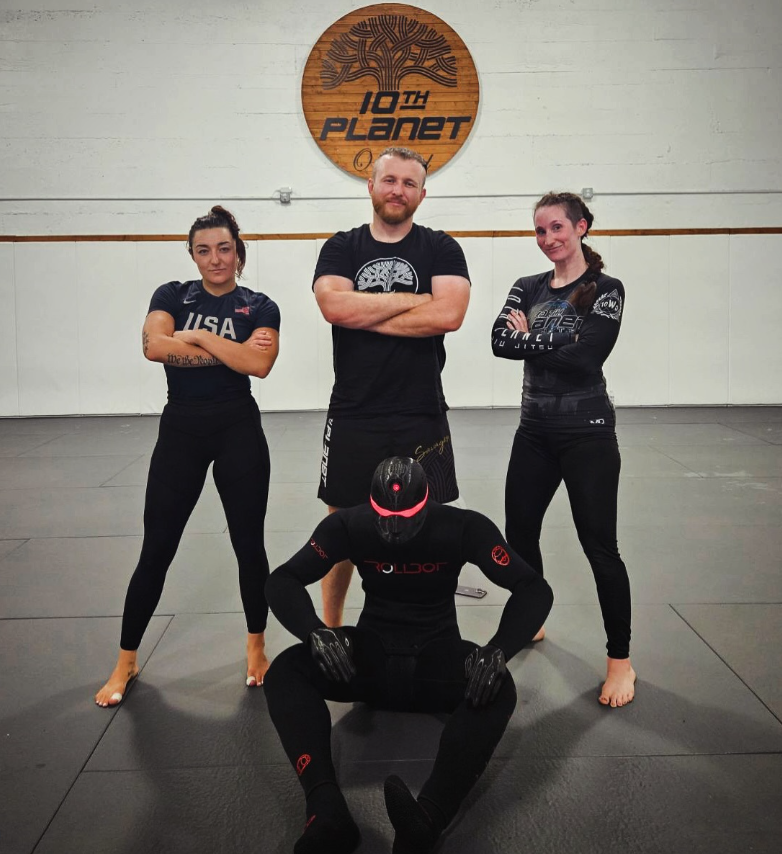
When Rollbot sent 10th Planet Oakland founder and head coach Michael Hillebrand one of its advanced grappling dummies to test, it created an opportunity to explore a training tool designed to solve some interesting problems in submission training.
Hillebrand was joined during the testing by 10th Planet black belt and longtime training partner Bre Stikk, giving the team an opportunity to experiment with the technology from the perspective of experienced grapplers.
Unlike a traditional grappling dummy, Rollbot was engineered with articulated joints designed to simulate aspects of human joint movement, including responses to locks, hyperextension and breaking forces. Its patented design specifically describes simulated joints that can be used for practicing bars, locks, holds, breaks and hyperextensions.
There were several interesting applications, from safely repeating submissions to slowing techniques down and experimenting with small adjustments.
But one stood out above the rest:
the ability to study true breaking mechanics.
From Getting the Tap to Understanding the Break
There is an unavoidable limitation when practicing submissions with another person.
You can’t actually break your training partners.
In responsible Jiu Jitsu training, the athlete applying the submission stops when their partner taps. That’s essential for safety, but it also means most grapplers can spend years practicing submissions without ever experiencing what happens mechanically beyond that point.
And there can be an important difference between a technique that gets someone to tap and one in which the control, positioning and force are properly aligned to create a true structural break.
Rollbot gave us an unusual opportunity to explore that difference.
With simulated internal joint structures designed to react to breaking forces, we could take certain submissions beyond the point where a human training partner would have tapped and study what actually happened.
Sometimes that meant discovering that a submission that felt strong still had room for improvement.
Could the joint be isolated better?
Could we remove another degree of movement?
Was the breaking force traveling in the most efficient direction?
Could a small change in angle dramatically increase the effectiveness of the finish?
Those are difficult questions to fully explore on another human being because good training partners tap long before you ever want to find out the answer.
For Hillebrand, that made Rollbot less interesting as simply another grappling dummy and more interesting as a laboratory for submission mechanics.
Research. Test. Refine.
That experimentation reflects a larger coaching philosophy at 10th Planet Oakland.
We don’t believe something is better simply because it’s new.
But we do believe coaches should remain students themselves—continuing to research new training methods, learn from accomplished athletes and coaches, experiment with emerging technology and test ideas against live resistance and competition.
Some ideas become part of how we train.
Others don’t.
The important part is continuing to ask questions.
That same philosophy has led the Oakland coaching team to explore different approaches to skill acquisition, exchange information with high-level competitors from inside and outside the 10th Planet system, and continually refine how Jiu Jitsu is taught at the academy.
The Rollbot experiment was another part of that process.
The training footage ultimately traveled far beyond the academy, being republished by multiple media outlets and generating millions of views across social platforms.
But the viral video wasn’t the most valuable part for us.
It was the opportunity to explore something that responsible grapplers almost never get to experience during normal training:
the difference between a submission that gets the tap and the mechanics required to create the break.
And then take what we learned back to the training room.